
The earth observation satellite would provide real-time images of the country and also be able to quickly monitor natural disasters.

India and the US on Friday said they have started talks to put in place a strategic framework for human space flight by year-end as they plan to send an Indian astronaut to the International Space Station in 2024.
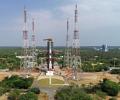
Days after landing on the Moon, India will aim for the Sun on Saturday with its maiden solar expedition, as ISRO's trusted PSLV will carry the Aditya L1 mission on a 125-day voyage to the Sun.

The finding may help understand the types of planetary systems that exist beyond our own.

The Chandrayaan-2 spacecraft is expected to reach the moon's orbit on August 20 and land on lunar surface on September 7.

The Indian Space Research Organisation (ISRO) will perform the final manoeuvre on Saturday to inject Aditya-L1 spacecraft -- the first space-based Indian observatory to study the Sun -- into its final destination orbit, some 1.5 million kilometres from the Earth.

'Good Earth was more a passion than a business for a long time,' Anita Lal tells Anjuli Bhargava. 'Today, I can assure you I know more about retail than most, but I learnt it all the hard way.'
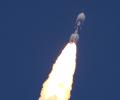
India's first solar mission, if successful, will showcase ISRO's ability to explore the cosmos, explains Kumar Abishek.

ISRO chairman S Somanath said the success gave the space agency "greater confidence," as the GSLV will be next deployed in the NISAR mission, a collaborative effort with the US' NASA.

'A person weighing 68 kilograms on the Earth would weigh only over 11 kg on the Moon'

India on Wednesday joined an elite group of three nations to have sent a spacecraft on the Moon, as Chandrayaan-3 landed a rover on the lunar surface to explore the uncharted territories near the south pole.

The Vikram lander was 100 kilometers away from LRO, near Manzinus crater in the Moon's south pole region, when LRO transmitted laser pulses toward it on December 12 last year.

The successful launch of the maiden solar mission of the Indian Space Research Organisation came on the heels of the historic lunar landing mission - Chandrayaan-3.
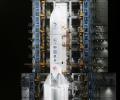
The debris from China's disintegrating Long March rocket entered the Earth's atmosphere on Sunday and reportedly fell into the Indian Ocean area close to the Maldives, the country's space agency said, ending an anxious week as people and the governments wondered where and when the space junk would fall.

India created history on Wednesday when the lander module of Chandrayaan-3 touched down on the lunar south pole, propelling the country to an exclusive club of four and making it the first country to land on the uncharted surface.

After the successful deployment of Chandrayaan-3's lander and rover on the moon, Indian Space Research Organisation (ISRO) is hoping that their mission life will not be limited to one lunar day or 14 earth days, and that they will come back to life when the sun again rises on the Moon, to carry on with the experiments and studies there.

The new year will witness two unmanned missions under the "Gaganyaan" project, deep ocean exploration project, "Samudrayaan" and many more.

Friday's mission is the fourth operational flight of LVM3 which aims to launch the Chandrayaan-3 spacecraft into a Geo Transfer Orbit.
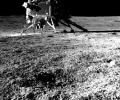
Chandrayaan-3 mission's Pragyan rover on Wednesday clicked an image of the Vikram lander, ISRO said.

ISRO aims to send humans into space on a Low Earth Orbit of 400 km for a three-day mission and bring them safely back to earth.

Four years after it broke many hearts, Indian Space Research Organisation's Chandrayaan is all set to soar towards the moon in its third expedition on Friday in an attempt to put the country in an elite club of nations that accomplished lunar missions with a soft landing.
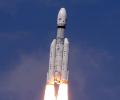
'ISRO takes a very cautious approach.' 'After reaching the moon, the orbit has to be brought down from a single elliptical orbit to a circular orbit while simultaneously ensuring the stability of Chandrayaan 3 and the health parameters of the lander and rover.'

Chandrayaan 3 follows the Chandrayaan 2 mission which did not achieve the desired soft landing on the surface of the moon in 2019, disappointing the scientists.

India will become the fourth country to master the technology of soft-landing on the lunar surface after the US, China and the erstwhile Soviet Union.
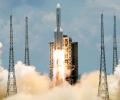
China on Thursday declined to comment on reports that the debris of its Long March 5B rocket, which last week launched the core module of the country's space station, is set to re-enter the earth's atmosphere this weekend, amid concerns that it could cause damage if it crashes in civilian areas.

The spacecraft will now prepare for separation of the lander module -- comprising the lander and rover -- from the propulsion module.

Deciphering its secrets will unlock the early history of not only our planet, but also of the star system, explains Kumar Abishek.

Lander Module of Chandrayaan-3 spacecraft comprising the lander and rover has successfully separated from the Propulsion Module, Indian Space Research Organisation said on Thursday.

The entire process being autonomous when the lander has to fire its engines at the right times and altitudes, use the right amount of fuel, and scan of the lunar surface for any obstacles or hills or craters before finally touching down.
Breaking its silence on its tumbling space rocket, whose debris is expected to fall on Earth this weekend, China said most of it would be burnt during re-entry and it is "highly unlikely" to cause any damage on the ground.

In a giant leap for its space programme, India's Moon mission Chandrayaan-3 touched down on the lunar south pole at 6.04 pm on Wednesday, propelling the country to an exclusive club of four and making it the first country to land on the uncharted surface.

So, if ISRO is able to revive them as the Sun rises on the Moon again, information that is derived from experiments that could once again be conducted by the Chandrayaan-3 payloads would be a "bonus".
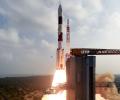
The 2,268-kg GISAT-1 was originally slated to be launched from Sriharikota in Andhra Pradesh's Nellore district, about 100 kms north of Chennai, on March 5 last year but was postponed a day before the blast-off due to technical reasons.

We asked colleagues, present and past, to reflect on a man who has made such a difference to their lives and careers. Here it is then, a rich collection of memories that offer enchanting glimpses of the enigmatic Ajit Balakrishnan.

People gathered in educational institutions, offices, city squares and religious places to watch the Indian Space Research Organisation's live telecast of Chandrayaan-3's final descent to the uncharted surface of the lunar south pole.

The entire mission operations of Chandrayaan-3, right from the launch till landing, "happened flawlessly" as per the timeline, the team that led India's third mission to the Moon said on Wednesday.

Somanath thanked all those who prayed for the mission's success, and ISRO veterans like A S Kiran Kumar , the space agency's former chief.

At this year's TIME ball in New York City on Thursday, April 25, you would have run into a Coimbatore-born American scientist, looking lovely in Sabyasachi Mukherjee designer finery, who would most likely have been hanging out with Dua Lipa.

The observation is the most detailed of its kind to date, demonstrating Webb's unprecedented ability to analyse distant atmospheres, according to NASA. WASP-96 b is one of more than 5,000 confirmed exoplanets in the Milky Way.
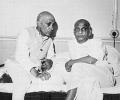
The Gujarat legislative assembly was adjourned for 15 minutes on Thursday following chaos in the House as the opposition Congress strongly objected to Bharatiya Janata Party leader and former deputy chief minister Nitin Patel's remark on India's first prime minister Jawaharlal Nehru.
